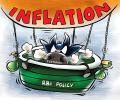
The Reserve Bank of India on Friday retained its projection for retail inflation at 4.5 per cent for the current fiscal assuming a normal monsoon, while emphasising that uncertainties related to food price outlook warrant a close monitoring. Consumer Price Index (CPI)-based retail inflation has been projected at 4.5 per cent with quarter-wise projections at 4.9 per cent in Q1 (April-June), 3.8 per cent in Q2, 4.6 per cent in Q3, and 4.5 per cent in Q4.

If the industrial sector expanded, growth rate is likely to rise in the remaining quarters to reach 7.6-7.8 per cent for 2017-18.

Its revenue grew 8.5 per cent to Rs 23,665 crore in the quarter under review from Rs 21,803 crore in the corresponding period last fiscal.

A Rs 525-crore contingency provision during the July-September period led to a 19 per cent fall in IndusInd Bank's share price on Friday (October 25). Contingency provisions are generally made when a lender expects more bad loans in the coming quarters. Shares of the bank on Tuesday (October 29) declined 1.53 per cent to settle at Rs 1,038.2 apiece on the BSE.

In the manufacturing sector, output is expected to decline by about 70 per cent as only food-processing, and drugs and pharma industries are allowed to operate while other segments, such as engineering and metals, have shut operations.

Tyre stocks have been on a tear over the past six months, with average returns exceeding 45 per cent. Except for Apollo Tyres, which has seen a slight correction in the last month and a half, limiting its gains to 16 per cent, listed peers such as MRF, CEAT Tyres (formerly Cavi Elettrici e Affini Torino), and JK Tyre & Industries have delivered returns exceeding 30 per cent during this period. Production-related constraints and sluggish demand in Europe, where sales are expected to remain flat, coupled with high valuations, have contributed to Apollo Tyres' underperformance. The tyre sector's gains can be attributed to robust growth trends driven by the replacement market, which constitutes more than two-thirds of sales.

The combined market capitalisation of Adani Group companies fell by Rs 54,876 crore, to Rs 10.92 trillion, as investor sentiment turned bearish on Wednesday. Shares of Adani Transmission fell by 7.7 per cent to close at Rs 886 while those of Adani Power lost 7.1 per cent to end the day at Rs 323. The stock of Adani Enterprises, the flagship company of the group, lost 6.2 per cent to finish at Rs 2,530.


In the July to September quarter of 2023-24 (Q2FY24), Voltas' revenues grew by 29.7 per cent year-on-year (Y-o-Y), but the adjusted net profit was down by 63 per cent Y-o-Y. The revenues hit Rs 2,290 crore, led by growth in the Unitary Cooling Products segment (up 15.4 per cent Y-o-Y, and in the EMP (Electromechanical project) business (up 66.8 per cent Y-o-Y). The UCP revenue rose to Rs 1,200 crore in Q2FY24, driven by volume growth despite weak consumer spending - the three-year annual growth is 18 per cent.
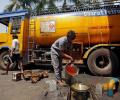
The medium-term scenario for oil marketing companies (OMCs) is high risk due to the surging crude and gas prices. Apart from OPEC-plus cutting production, the Hamas-Israel conflict has caused fears of supply disruption. The July-September quarter of 2023-24 (Q2FY24) saw positive surprises for OMCs. Strong gross refining margins (GRMs) more than offset weak marketing margins.

Two young men jostle in a rickshaw as it clatters along a narrow, bustling lane of North Kolkata, each with a leg dangling over the side of the vehicle, a bulging sack of cosmetics nestled between them. The protagonists here are the founders of Emami - Radhe Shyam Agarwal and Radhe Shyam Goenka - childhood friends who gave up cushy corporate jobs to build a fast-moving consumer goods (FMCG) company. From a 200-square-foot rented space on Muktaram Babu Street in North Kolkata, brand Emami stepped into the competitive world of FMCG 50 years back, armed with just three products: Vanishing cream, talcum powder, and cold cream.

Unseasonal rains watered down the performance of consumer durables companies as temperatures cooled, impacting the sales of refrigerators and air conditioners (ACs) in the 2023-24 (FY24) April-June quarter. Centrum says in its report on the sector that the trade channel indicates a 25-30 per cent year-on-year (YoY) decline in sales of refrigerators and ACs in April and May due to restricted buying. "While some green shoots in demand were visible in June, overall growth for the quarter is likely to remain at a negative 10-12 per cent," observes the brokerage.
Shares of ICICI Bank may outperform those of HDFC Bank in the near-term, analysts said recently, after the Sandeep Bakhshi-led private sector lender reported a strong set of numbers for the July to September quarter (Q2) of financial year 2023-24 (FY24). The result, they said, reiterated that ICICI Bank is maintaining a sustainable and prudent growth led by tech-driven initiatives as against HDFC Bank, which is facing merger related challenges. According to analysts at Prabhudas Lilladher, ICICI Bank is valued at par with HDFC Bank at 2.2x/1.9x on FY25/26E core adjusted book value (ABV) basis.

In the April-June quarter (Q1) of 2023-24 (FY24), growth in sales of FSN E-Commerce Ventures (the parent company of Nykaa) decelerated to 24 per cent year-on-year (Y-o-Y), and 9 per cent quarter-on-quarter (Q-o-Q), compared with 34 per cent in the previous quarter, due to a decline in the beauty & personal care (BPC) and fashion division's gross merchandise value (GMV). But Nykaa claimed it gained market share in both divisions. The earnings before interest, taxes, depreciation, and amortisation (Ebitda) margin of 5.2 per cent expanded 120 basis points (bps) from a year earlier.

From premium electric motorcycles to mass-market scooters, manufacturers are rapidly expanding their portfolios to capture a larger share of the booming market.

The Nifty IT index, data shows, has outperformed the markets in each of the last four election years post the result. announcement.

Billionaire Mukesh Ambani's Reliance Industries Ltd on Friday reported a 46 per cent jump in net profit for the three months ended June on the back of bumper earnings from oil and telecom businesses. The oil-to-retail-to-telecom conglomerate's consolidated net profit rose to Rs 17,955 crore during April-June period -- the first quarter of 2022-23 fiscal year -- from Rs 12,273 crore in the year-ago period, it said a stock exchange filing.

Mutual funds (MFs) managed a record Rs 66.2 trillion in assets during the July-September quarter, marking a 12.3 per cent increase over the previous three-month period - the highest quarterly jump in MF assets in at least five years. During the April-June period, the average assets under management (AUM) stood at Rs 59 trillion. The sharp rise in AUM, according to experts, is driven by a robust equity market rally and record inflows into equity schemes.
.jpg)
India's economy grew 4.7 per cent in 2013-14, following an expansion of 4.5 per cent in 2012-13. In the fourth quarter of 2013-14, growth remained subdued at 4.6 per cent, mainly due to a decline in manufacturing and mining output.

The Reserve Bank of India on Friday revised upwards the GDP growth projection for the current fiscal to 7.2 per cent from 7 per cent on rising private consumption and revival of demand in rural areas. Unveiling the bi-monthly monetary policy, RBI Governor Shaktikanta Das said estimates released by the National Statistical Office (NSO) placed India's real gross domestic product (GDP) growth at 8.2 per cent in 2023-24. "During 2024-25 so far, domestic economic activity has maintained resilience," he said, adding that manufacturing activity continues to gain ground on the back of strengthening domestic demand.
It's all eyes on the consumer durables sector during the festival season after a weak Q1FY24 and Q2FY24 was impacted by an erratic monsoon. Traditionally, this period sees the highest number of purchases. Dealers and manufacturers are complaining about low business-to-consumer (B2C) off-take during the first half.

Siemens's share price has lost ground in the past few sessions following weak management commentary. The management indicated challenges to the growth outlook due to stagnant private capex and concerns over semiconductor shortages for digital industries. Government infra-spending may regain momentum from January 2025.

A muted revenue performance in the September quarter and weak management commentary weighed on the stock of consumer major Marico which shed 8.5 per cent to Rs 542 from its intraday highs on Tuesday. The company indicated that demand trends were similar to that of the June quarter with instances of increasing food prices and below-normal rainfall distribution in some regions impeding the anticipated recovery in rural demand.

The country's current account deficit is likely to hit a three-year high of 1.8 per cent or $43.81 billion in FY22, as against a surplus of 0.9 per cent or $23.91 billion in FY21, a report said on Thursday. According to an assessment by India Ratings, the Current Account Deficit (CAD) has moderated to $17.3 billion or 1.96 per cent of GDP in the fourth quarter of FY22 as against $8.2 billion or 1.03 per cent in the year-ago period, and massively down from $23.02 billion or 2.74 per cent in Q3, which was a 13-quarter high. The improvement in the key numbers are due to the remarkable improvement in merchandise exports in FY22, when it grew 42.4 per cent as against a negative 7.5 per cent in the pandemic-hit FY121.

Food delivery firm Zomato Ltd said on Wednesday most stores of its grocery unit Blinkit had resumed operations after being shut following protests by delivery partners. "Over the last few days we have made changes in the delivery partner payout structure with respect to the Blinkit business to address the needs of delivery partners, improve customer experience and reduce cancellation/ order rejection frauds by few delivery partners in the system. "Such changes are done from time to time, as needed," said the company in a letter to the BSE.

The two IT majors -- Infosys and TCS -- delivered disappointing results for the fourth quarter of the 2022-23 financial year (Q4FY23). Poor macro conditions and weak sentiment in the banking, financial services and insurance (BFSI) space accounted for the miss. For TCS, revenue in constant currency (CC) terms grew at 0.6 per cent on a quarter-on-quarter (QoQ) basis. Weakness was visible in North America, primarily due to deferred discretionary spending.

'We have not seen too many large deals compared to last quarter.'

Sun Pharmaceutical Industries (Sun Pharma) reported a turnaround in the January-March quarter of the 2022-23 financial year (Q4FY23), declaring a profit after tax (PAT) of Rs 1,984 crore versus a loss of Rs 2,277 crore in Q4FY22. However, that loss in FY22 was due to several exceptional one-time items -- with Rs 3,723.15 crore allocated to settlement of lawsuits in the US and other Exceptional Items adding up to Rs 3,935.75 crore. Adjusted for exceptional items, PAT in Q4FY22 amounts to Rs 2,155 crore, which is a year-on-year (YoY) growth of about 36 per cent.

Gains in auto shares helped offset losses in select index heavyweights led by Infosys.

Management commentary on demand environment, and forward guidance will be in focus when Indian IT services players declare their September quarter results for financial year 2024-25 (Q2FY25). The industry is exepected to have continued on the path of recovery in Q2, similar to the preceding quarter, rather than sprint towards growth. The top four firms likely grew between 0 per cent and 4 per cent year-on-year (Y-o-Y), according to consensus estimates.

UltraTech Cement's results for the fourth quarter results of the 2022-23 financial year (Q4FY23) were broadly in line with the Street estimates. The consolidated revenue, operating profit and net profit stood at Rs 18,700 crore, Rs 3,300 crore and Rs 1,670 crore, respectively, which were up 18 per cent, 8 per cent and 13 per cent YoY, respectively.
After nearly four years of underwhelming performances in equity schemes, Aditya Birla Sun Life Mutual Fund (ABSL MF) is experiencing a revival. During the first quarter of the 2023-24 financial year (Q1FY24), the fund house arrested its declining market share, bolstered by stronger equity fund results and subsequent ratings upgrades. Mahesh Patil, the chief investment officer, attributes this resurgence to changes in the fund management team and adjustments to investment strategies.

Corporate margins and profits in India remain vulnerable to changes in crude oil prices in the international market. Historical quarterly data from listed companies (excluding banks, finance and insurance, oil and gas, and power sectors) indicate an adverse correlation between corporate margins and crude oil prices.
ICICI Bank has reported a 44.67 per cent jump in net profit on a consolidated basis at Rs 336.89 crore (Rs 3.368 billion) for the first quarter ending June 30, 2003 as compared to Rs 232.86 crore (Rs 2.328 billion) for same quarter last fiscal.

Jet Airways will restart domestic operations by the first quarter of 2022 and short haul international flights by the last quarter of the next year, Jalan Kalrock Consortium, the winning bidder for the grounded airline, stated on Monday. The first flight of Jet Airways would be on Delhi-Mumbai route, it mentioned, adding that the airline would now be headquartered in Delhi instead of Mumbai. The National Company Law Tribunal (NCLT) in June this year had approved the Jalan Kalrock Consortium's resolution plan for Jet Airways, two years after the once-storied full-service carrier went into insolvency proceedings.

The second-quarter performance of the top five information-technology services firms gives the hint that slow growth has bottomed out on the back of discretionary spending kicking in for the sector's largest vertical - the banking and financial services. However, concern about the macro-environment continues to be a challenge. Among the top four - Tata Consultancy Services (TCS), Infosys, HCLTech, and Wipro - it is Bengaluru-based Infosys that has performed the best and that was evident in its full-year revenue guidance.

Telecom operator Bharti Airtel on Thursday posted a net profit of Rs 1,612 crore for the first quarter ended June 2023, which is nearly flat over earnings in the same period of the previous year. The revenue for the just-ended quarter was 14 per cent higher at Rs 37,440 crore compared to the year-ago period "backed by strong and consistent performance delivery across the portfolio", the company said.

The Crisil study covered 600 companies excluding financial services and oil companies, representing 71 per cent of the overall market capitalisation of India Inc.
The environment looks conducive for growth for corporate India and thus we believe that equities would continue to deliver decent returns over the long term. \n\n

Trading in the equity market this week will be highly influenced by a host of important triggers, with quarterly earnings from IT majors TCS, Wipro, and domestic inflation and IIP data taking the centre stage in dictating the movement in equities, analysts said. Besides, global factors and trading activity of foreign investors will also drive markets. "We are approaching the first quarter earnings season, with HCL Tech, TCS and Wipro set to report their earnings this week.
